
Lumebox vs. Hooga (2026): An Honest Test on Skin Radiance, Muscle Recovery & True Value

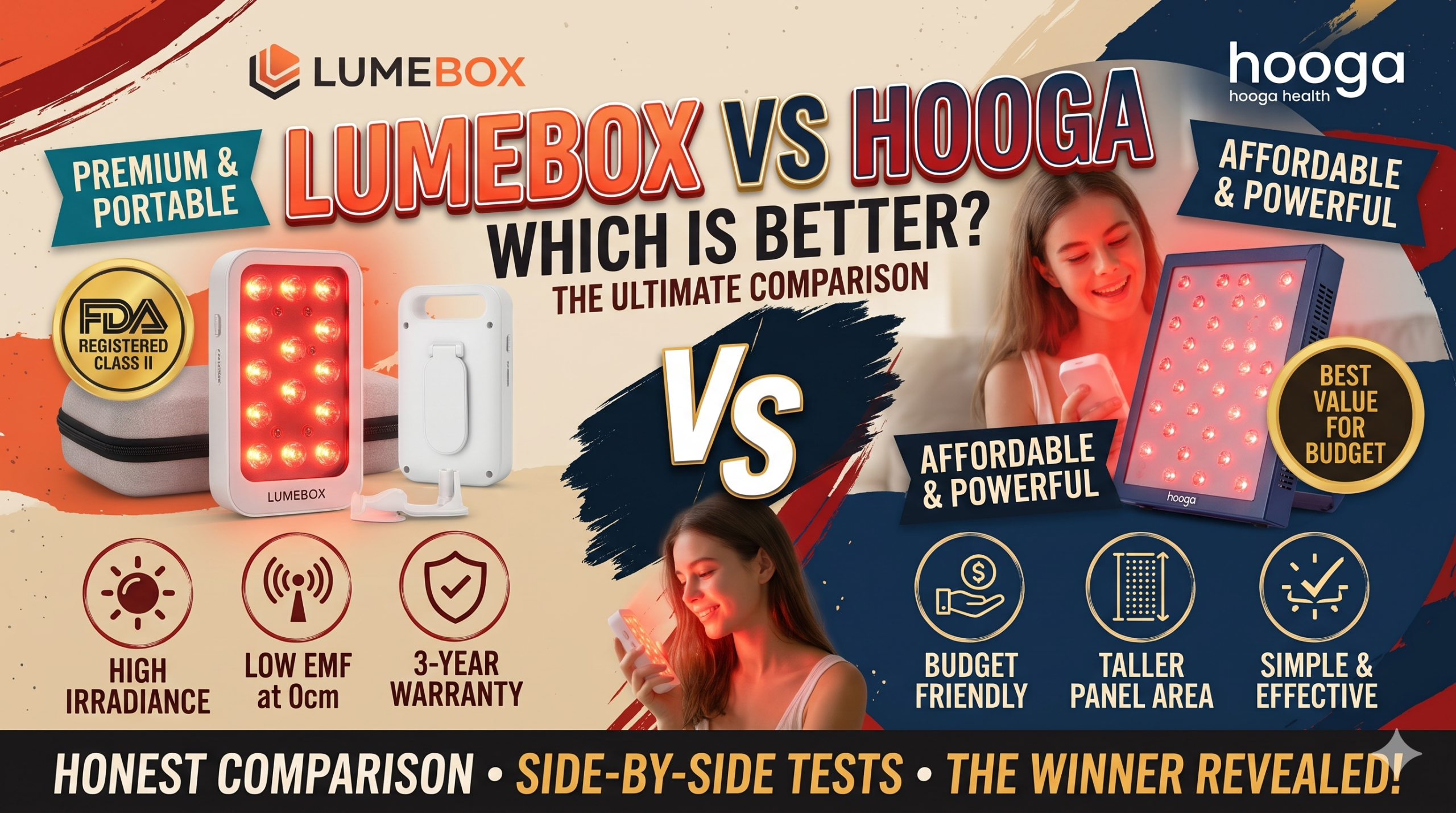
If you have spent any time down the at-home wellness rabbit hole, you know that red light therapy has officially crossed over from clinical dermatology offices straight into everyday routines. And as soon as you start researching the best devices to invest in, two brand names repeatedly face off: Lumebox and Hooga.
At first glance, pitting them against each other seems like a natural match—after all, their price tags often hover around a similar baseline ($300 to $400). But evaluating them without understanding their core engineering leads to an immediate mismatch: they embody two completely different design philosophies.
Hooga established its reputation as the budget-friendly champion of heavy, stationary wall and door panels. Lumebox, developed under the guidance of an integrative medical physician, was engineered from the ground up as a high-irradiance, medical-grade portable device designed for concentrated joint, muscle, and facial application. While Hooga also manufactures small handheld units, they differ substantially from Lumebox in power density, safety testing, and build quality.
If you are trying to decide where to put your money, this comprehensive breakdown walks through the physics, optical specifications, everyday ergonomics, and clinical applications of both brands so you can choose the ideal tool for your routine.
Quick Comparison: Lumebox 2.0 vs. Hooga Options
| Feature | Lumebox 2.0 (Portable Pro) | Hooga PRO 1500 (Full-Body Panel) | Hooga Handheld / Portable |
| Primary Form Factor | Cordless Handheld Targeted Device | Heavy Stationary Door/Wall Panel | Budget Handheld Unit |
| Power Source | Internal DC Rechargeable Battery | AC Wall Plug-in | Battery / Plug-in |
| Wavelengths | 660 nm (Red) & 850 nm (NIR) | 660 nm (Red) & 850 nm (NIR) | 660 nm (Red) & 850 nm (NIR) |
| LED Architecture | Dual-Chip (Both wavelengths in all 15 diodes) | Dual-Chip (300 High-Output Diodes) | Basic Single/Split Diodes |
| Peak Irradiance | ~125–140 mW/cm² | High at distance (~100 mW/cm² at 6″) | ~90 mW/cm² |
| EMF at Direct Contact | 0.2 µT (Lab-Tested at 0 cm) | Low at 6″ (Elevated at chassis) | Tested only at 6″ distance |
| Optical Flicker | Zero (Regulated DC Power) | Potential AC Mains Flicker | Variable |
| Medical Clearance | FDA-Registered Class II Device | Standard Consumer Clearance | Standard Consumer Clearance |
| Best Used For | Targeted joints, face, neck, travel, scars | Whole-body athletic recovery at home | Low-cost spot treatment |
| Standard Pricing | $629 MSRP (Drops to ~$369 on promo) | ~$399 | ~$150–$200 |
1. Two Different Design Philosophies: Panel vs. Portable
The primary reason shoppers get confused when researching Lumebox vs. Hooga is the disparity in form factor.
 STATIONARY FULL PANEL (e.g., Hooga PRO 1500)
┌────────────────────────────────────────────────────────┐
│ • Fixed mount to door or wall frame │
│ • High-draw AC power cord │
│ • Treats broad surface area (torso, back, legs) │
│ • Must stand or sit undressed 6–12 inches away │
└────────────────────────────────────────────────────────┘
 VS.
 TARGETED PORTABLE (e.g., Lumebox 2.0)
┌────────────────────────────────────────────────────────┐
│ • Cordless, handheld, internal lithium-ion battery │
│ • Direct skin-contact capability (zero standoff) │
│ • Treats specific joints, facial contours, or tendons │
│ • Usable anywhere: couch, bed, desk, or travel │
└────────────────────────────────────────────────────────┘
The Stationary Panel Route (Hooga PRO Series)
If your primary wellness objective is sweeping, whole-body photobiomodulation—such as stimulating systemic recovery across your entire anterior or posterior chain following intense athletic training—a large panel like the Hooga PRO 1500 is hard to beat for raw square-inch coverage. In a single 10-minute session, you stand in front of 300 LEDs that illuminate your chest, abdomen, quads, or entire back.
The trade-off? Inconvenience and immobility. Panels require permanent or semi-permanent mounting on a sturdy door or heavy floor stand. They must remain plugged into a wall outlet, their cooling fans generate noticeable background noise, and they demand that you schedule dedicated time to stand in one spot.
The Targeted Portable Route (Lumebox 2.0)
The Lumebox 2.0 serves an entirely different lifestyle need: concentrated precision. It was designed by an integrative physician when searching for a high-powered solution for localized nerve and joint pain that could be held directly against the problem area without tethering the user to a wall.
Instead of bathing an entire room in light, Lumebox concentrates clinical-grade photons directly into specific target zones: an arthritic knee, an inflamed rotator cuff, a stiff lumbar region, a post-surgical scar, or the face and neck. Because it is battery-operated, compact, and completely quiet, daily compliance is effortless—you can treat your knee or neck while reading in bed, answering emails at your desk, or traveling.
2. Optical Physics: Wavelengths and Irradiance Compared
In photobiomodulation, cosmetic glow means nothing without correct wavelength calibration and adequate power density (irradiance).
Targeted Photons (660 nm Red / 850 nm Near-Infrared)
 │
 ▼
Mitochondrial Cytochrome c Oxidase (CCO) Activation
 │
 ▼
Displacement of Inhibitory Nitric Oxide (NO) ──> ATP Production Surge
The Wavelength Match: 660 nm vs. 850 nm
Both Lumebox and Hooga center their core devices around the two most clinically researched wavelengths in photobiomodulation:
- 660 nm (Deep Red): Absorbed primarily within the top layers of the skin (stratum corneum down through the dermis). It triggers procollagen synthesis, calms surface redness, accelerates wound closure, and evens skin tone.
- 850 nm (Near-Infrared / NIR): Bypasses surface melanin and water barriers to penetrate 2 to 5 centimeters into deeper anatomical structures—muscles, joint capsules, tendons, ligaments, and bones.
Dual-Chip Innovation: The Lumebox Edge
Where Lumebox pulls ahead in handheld engineering is diode architecture. Budget-friendly devices often alternate individual diodes: one bulb produces red, the adjacent bulb produces near-infrared. This cuts your effective treatment coverage for any single wavelength in half.
Lumebox utilizes custom dual-chip emitters across all 15 of its high-output diodes. Both 660 nm and 850 nm chips are housed within every single bulb. Whether you run red light for your complexion, near-infrared for deep tissue, or both simultaneously, 100% of the active aperture delivers therapeutic light.
The Irradiance Battle
Irradiance—measured in milliwatts per square centimeter (mW/cm²) – dictates the dosage of energy (mW/cm²) your cells absorb per minute:
- Lumebox 2.0: Outputs approximately 125 mW/cm² (Red) and 140 mW/cm² (NIR) at close range. This high flux density delivers a therapeutic clinical dose in quick 6- to 12-minute treatment windows.
- Hooga Portable Handheld: Typically tops out around 90 mW/cm², meaning longer session times are required to deliver an equivalent energetic dose to targeted tissue.
- Hooga PRO 1500 Panel: Delivers high total light output across a wide field, but because you must stand 6 to 12 inches away to achieve full-body coverage, the effective irradiance arriving at your skin diminishes rapidly with distance according to the inverse-square law of light.
3. Direct Matchup: Lumebox 2.0 vs. Hooga Portable
Many shoppers specifically want a compact device and compare Lumebox against Hooga’s smaller portable offerings rather than its giant panels.
| Engineering Factor | Lumebox 2.0 | Hooga Portable Handheld |
| Optical Irradiance | ~125–140 mW/cm² (Lab-Verified) | ~90 mW/cm² (Manufacturer Spec) |
| Diode Technology | 15 Dual-Chip LEDs (660 & 850 nm simultaneous) | Basic split diodes / single spectrum |
| Chassis Quality | Anodized solid aluminum shell | Molded commercial-grade plastic |
| Direct Contact EMF | Independently verified 0.2 µT at 0 cm | Tested only at 6-inch standoff |
| Optical Safety | Regulated DC power (zero flicker) | Basic internal DC circuit |
| Warranty & Class | FDA-Registered Class II Device | Consumer electronic clearance |
While Hooga’s portable handheld is an accessible budget entry point, Lumebox 2.0 feels like a precision clinical instrument. The higher irradiance and dual-chip diodes mean you spend less time treating each spot while delivering deeper photon penetration to underlying tissue.
4. Safety Standards: Direct-Contact EMF and Optical Flicker
When holding an electronic device close to your vital organs, joints, or facial nerves, electrical engineering standards become paramount.
THE EMF TESTING REALITY CHECK
┌────────────────────────────────────────────────────────┐
│ Standard Industry Practice: │
│ "Zero EMF" claimed by measuring 6 inches away. │
│ (Misleading for devices meant to touch skin!) │
├────────────────────────────────────────────────────────┤
│ Lumebox Laboratory Standard: │
│ 0.2 µT independently verified at 0 cm (Touch-Contact) │
│ (Negligible exposure even when resting on bare skin) │
└────────────────────────────────────────────────────────┘
Direct-Contact (0 cm) EMF Testing
Electromagnetic fields naturally dissipate over distance. Many consumer red light manufacturers exploit this physical rule by testing their devices 6 inches away, where the sensor reads near zero, and advertising “zero EMF.”
However, for a handheld recovery tool meant to rest directly against your knee, hip, or lower back, a 6-inch reading is completely irrelevant. Lumebox submitted their device to third-party testing at 0 cm (direct physical contact), registering an ultra-low 0.2 µT—an emission level 50 to 100 times lower than a standard handheld hair dryer. Hooga lists low EMF levels, but primary measurements rely on standard standoff distances.
AC Mainline Optical Flicker vs. DC Battery Power
Most stationary panels, including Hooga, draw power directly from alternating current (AC) wall outlets. Unless equipped with expensive internal smoothing transformers, AC power can produce microscopic optical flicker cycling at 60 Hz or 120 Hz. While often imperceptible to the naked eye, sub-perceptible flicker can induce eye fatigue, headaches, or neurological strain in light-sensitive users.
Because the Lumebox 2.0 operates strictly on internal direct-current (DC) battery power, its light beam is continuous, steady, and free of optical flicker.
5. Real-World Usability: Which Fits Your Daily Life?
Testing these units across daily routines reveals distinct operational advantages depending on your specific physical needs:
PRACTICAL SCENARIO SHOWDOWN
Scenario A: Post-Leg-Day Athletic Recovery
Winner: Hooga PRO 1500 Panel
• Stand in front of the panel for 10 minutes; both quads, knees, and shins are treated at once.
• Lumebox would require moving the device from zone to zone, turning a 10-minute session into a 40-minute chore.
Scenario B: Acute Knee Pain, Stiff Lower Back & Office Tension
Winner: Lumebox 2.0
• Press the device directly against your kneecap or lean against it on your office chair while answering emails.
• Zero setup, zero undressing, completely cordless.
Scenario C: Facial Anti-Aging & Travel Maintenance
Winner: Lumebox 2.0
• Packs into its protective hardshell case for hotel rooms and flights.
• Provides high-intensity facial rejuvenation without tying you to a wall outlet.
6. Pros and Cons Breakdown
Lumebox 2.0
- Pros:
- High optical irradiance (~125–140 mW/cm²) enables rapid 6- to 12-minute sessions.
- Cordless, rechargeable lithium-ion battery (up to 140 minutes of continuous runtime).
- True dual-chip diodes (660 nm and 850 nm emitted simultaneously in every bulb).
- Independently verified low-EMF at 0 cm contact (0.2 µT) and zero DC optical flicker.
- FDA-registered Class II medical device; HSA/FSA eligible.
- Ultra-portable with an included hardshell travel case.
- Cons:
- Smaller aperture makes full-body head-to-toe sessions impractical.
- Highly sensitive capacitive touch button can switch modes if grazed accidentally.
- Premium retail price ($629 MSRP, though promotional links drop it to ~$369).
- Hands-free facial use requires propping it up or purchasing the tabletop stand ($59).
Hooga Devices (PRO 1500 Panel & Portable)
- Pros:
- Exceptional square-inch coverage per dollar on their stationary panels.
- Large panels treat entire muscle groups (quads, back, chest) in a single 10-minute pass.
- Solid industrial metal casings built for home gyms.
- Lower upfront retail cost across budget portable lines (~$150–$200).
- Cons:
- Panels require dedicated floor space or door mounting and a wall outlet.
- Panel cooling fans generate noticeable background noise.
- Budget portable models deliver lower irradiance (~90 mW/cm²) and simpler single-diode layouts.
- Testing transparency for direct-contact EMF is less comprehensive on entry-level models.
7. Pricing, Warranties, and True Value for Money
Price context is essential when evaluating these two brands:
- Hooga PRO 1500: Retails around $399. For a large 300-LED stationary panel, this remains one of the best square-inch-per-dollar values in the red light market.
- Hooga Portable: Retails between $150 and $200. It is affordable, but offers lower optical intensity and a bulkier, basic aesthetic.
- Lumebox 2.0: Carries a standard retail tag of $629. However, through authorized medical and clinical affiliate partnerships, a $260 direct discount brings the cost down to approximately $369.
WHAT IS INCLUDED WITH LUMEBOX 2.0 (AT ~$369 PROMO PRICE):
• Lumebox 2.0 High-Output Dual-Wavelength Device
• Custom Hard-Shell Travel Case with Protective Molded Foam
• Removable Ergonomic Comfort-Grip Handle
• Medical-Grade Protective Blackout Goggles
• Universal AC Charger (110V–240V) & USB Charging Cable
• Step-by-Step Clinical Protocol Manual & Digital Kickstarter Guide
• 30-Day Money-Back Guarantee & Official Manufacturer Warranty
• Full HSA/FSA Healthcare Account Eligibility
At its full $629 sticker price, Lumebox faces stiff competition. But at the discounted ~$369 threshold, its combination of clinical irradiance, medical registration, certified contact safety, and solid metal build makes it a far higher-quality personal device than budget portable alternatives.
👉 Claim Your $260-Off Lumebox Promotional Discount Here
(Promotional code ‘lemonsforday’ auto-applies at checkout for $260 off, backed by a 30-day trial and HSA/FSA eligibility)
8. The Final Verdict: Which Device Wins?
The decision between Lumebox and Hooga ultimately comes down to your personal wellness routine:
Choose Hooga (Specifically the PRO Panel Series) If:
- Your primary goal is full-body athletic recovery, covering your chest, back, hamstrings, and quads in a single daily session.
- You have dedicated space in a home gym or bedroom to mount a heavy panel to a door or stand.
- You do not mind standing in front of a stationary wall unit every day and want the lowest cost per square inch of light.
Choose Lumebox 2.0 If:
- You need targeted, deep-penetrating relief for specific problem areas: stiff knees, a sore lower back, an aching shoulder, or surgical scars.
- You want a high-powered device for facial anti-aging, collagen building, and neck firming that does not require standing naked in front of a panel.
- You value cordless mobility: you want to use your device while sitting on the couch, working at your desk, or traveling.
- You prioritize verified medical engineering: dual-chip diodes in every bulb, tested 0 cm low-EMF safety, zero optical flicker, and FDA Class II clearance.
For dedicated full-body gym recovery, Hooga panels deliver outstanding value. But for versatile, everyday healing that seamlessly integrates into your daily life—from evening facial care to acute joint relief—Lumebox 2.0 is the superior, more practical long-term investment.
👉 Order the Lumebox 2.0 with Your Exclusive $260 Promotional Savings Here
Frequently Asked Questions
Can Lumebox replace a full-body Hooga panel?
Lumebox delivers equivalent or higher localized irradiance compared to a full-body panel, meaning a specific joint or area of your face receives the same therapeutic energy density. However, because its surface area is compact, using Lumebox to treat your entire body would require shifting it from spot to spot over 30 to 40 minutes. For whole-body coverage in a single 10-minute pass, a large panel remains the faster tool.
Is Hooga’s portable device equivalent to Lumebox?
No. While Hooga’s portable handheld units are budget-friendly, they typically emit lower irradiance (~90 mW/cm² compared to Lumebox’s ~125–140 mW/cm²), use simpler diode configurations rather than true dual-chip emitters in every bulb, and lack the independent 0 cm contact EMF testing documentation provided by Lumebox.
Can I use Lumebox directly against my bare skin?
Yes. On bodily areas such as knees, elbows, shoulders, hamstrings, and the lower back, direct contact is actually recommended—it minimizes optical reflection and maximizes photon delivery into deep joint capsules. For delicate facial skin, maintain a 6- to 12-inch distance and always wear the provided blackout safety goggles.
Can I pay for either device using HSA or FSA funds?
Because the Lumebox 2.0 is an FDA-registered Class II medical device cleared for pain alleviation, muscle recovery, and joint inflammation reduction, it is eligible for payment or reimbursement under most Health Savings Accounts (HSA) and Flexible Spending Accounts (FSA). You can use an HSA/FSA debit card directly at checkout or submit your receipt with an itemized claim.


